


5 min read
Highlights:
A customer visits your online store, selects a product, reaches checkout, and hesitates. They are interested, but not confident enough to pay online. Then they see one option that changes everything: Cash on Delivery.
For millions of Indian shoppers, COD is the reason they place an order.
Even today, a large share of e-commerce orders in India come from tier-2 and tier-3 cities, where customers prefer paying after seeing the product. Cash on delivery builds trust, especially for first-time buyers. At the same time, it brings challenges like delayed payments, higher returns, and working capital pressure.
Understanding how COD works helps online sellers decide when to offer it, how to manage cash flow, and how to reduce losses.
Cash on delivery is a payment method where customers pay the delivery person in cash upon receiving their order, instead of paying online during checkout. Popular across India’s e-commerce sector, COD addresses trust concerns amongst shoppers unfamiliar with digital payments or worried about product quality before seeing items physically.
Whilst digital payments processed over 130 billion transactions in 2024, 60% of consumer spending remains cash-based. For online sellers, this means excluding COD limits your potential customer base significantly, especially in regions with lower internet penetration, where COD accounts for 25% of orders.
RBI’s regulatory stance: Cash on delivery operates outside formal payment system regulation. RBI clarified in 2018 that COD collection isn’t authorised under the Payment and Settlement Systems Act 2007, distinguishing it from regulated payment gateways.
Real-life example:
A first-time shopper in a tier-3 city orders clothing from a new brand. They choose COD because they want to check the product before paying. Without COD, that order would not have happened.
Even though digital payments have grown rapidly, a large portion of consumer spending in India is still cash-based. For online sellers, removing COD can mean losing access to a big segment of buyers.
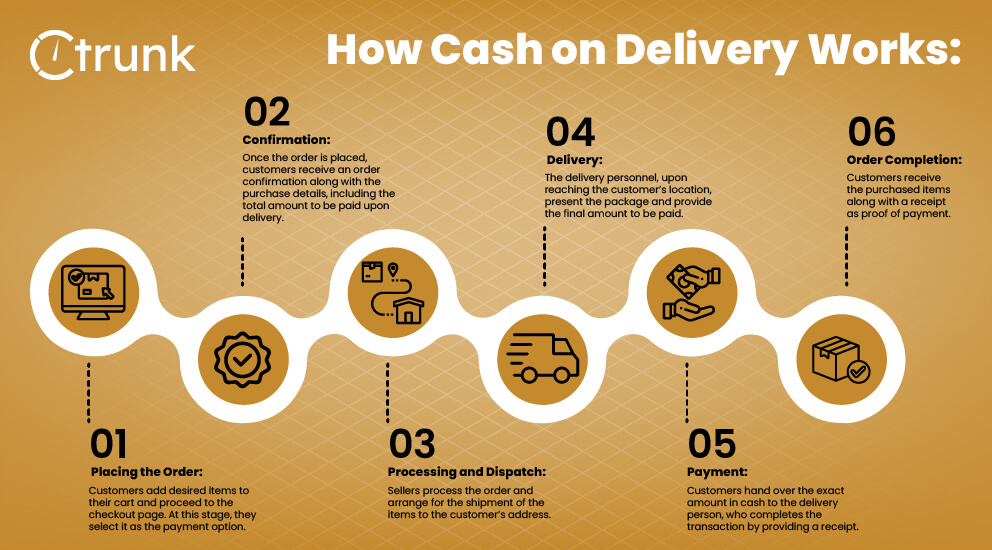
1. Customer selects COD at checkout
Your customer chooses cash payment during the order process instead of entering card or UPI details.
2. Order fulfilment and dispatch
You process and ship the order through your logistics partner, who handles cash collection.
3. Delivery and payment collection
The courier delivers the product and collects payment from the customer in cash.
4. Settlement to your account
Your logistics partner transfers collected funds to your business account after deducting fees.
Standard settlement timeline: 7-15 working days from delivery date. This gap affects inventory repurchase and advertising budgets during peak sales periods.
Early settlement option: Some logistics providers offer 2-3 day remittance (T+1/T+2), helping you maintain better cash flow during festive seasons or restocking cycles.
| Settlement Type | Timeline | Best For |
|---|---|---|
| Standard COD | 7-15 working days | Established sellers with stable cash flow |
| Early COD | 2-3 working days | Growth-stage brands needing quick capital rotation |
Higher return rates: COD orders show 20-30% return rates compared to 10% for prepaid. Customers who haven’t paid upfront more easily change their minds at delivery, creating return-to-origin (RTO) losses.
Strategies to reduce RTO:
Additional costs: Merchants pay logistics partners 2-7% commission on COD transactions, whilst many charge customers ₹5-49 handling fees per order. Factor these costs into the pricing strategy.
Reconciliation complexity: COD requires matching delivered orders with courier-collected payments. Automated reconciliation tools reduce manual effort and accounting errors.
Cash on delivery remains vital for reaching India’s diverse e-commerce audience; however, success requires striking a balance between customer convenience and operational efficiency. Understanding settlement timelines helps you plan working capital, whilst RTO reduction strategies protect profitability. Consider offering both COD and prepaid options, meeting customers where they are while encouraging lower-cost digital payments with targeted discounts.
1. What is cash on delivery in e-commerce?
COD is a payment method where customers pay cash to the delivery person upon receiving their order, instead of paying online. It’s popular amongst Indian shoppers, building trust with new sellers.
2. How long does COD settlement take for merchants?
Standard COD remittance takes 7-15 working days after delivery. Early COD services from logistics providers can settle funds in 2-3 days, helping merchants manage cash flow better.
3. Why do COD orders have higher return rates?
COD orders show 20-30% returns versus 10% prepaid because customers haven’t committed payment upfront. Some change their minds at delivery, creating RTO losses for sellers.
4. What fees do merchants pay for COD?
Merchants pay logistics partners 2-7% commission on COD collections, plus many charge customers ₹5-49 handling fees per order to cover cash collection costs.
5. How can I reduce COD return-to-origin losses?
Use order verification through OTP confirmation, set minimum order values for COD, restrict COD for high-risk locations, offer prepaid discounts, and partner with logistics providers offering RTO management features.


